Sunday, 27 March 2011

How to make yourself a lovely cup of Halogenoalkanes


Bond Fission

Bond Fission is a fancy term for Breaking Bonds.


Breaking Bonds can either be:
Homolytic
The electrons in the bond retract and split in between the molecules to form ions. Wonderful.


Heterolyric 
The electrons go to only one molecule, forming a Radical. Dun Dun Duuuuun.
(Common in Polar Bonds)
Radicals are generally provoked when a bond absorbs an unusual amount of energy, such as UV energy, this is why this happens quite a bit in the upper Stratospheric zone. This relates to Ozone damage et cetera. 


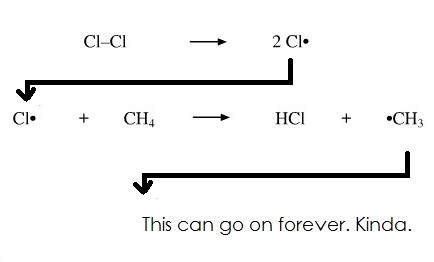
How Radicals form (Kinda, in context of Chlorine):

note: Radicals are bad because they're very reactive, and they can release chain/sequence reactions, deforming naturally occurring bonds, such as O3 (Ozone):

Initiation (When the first radical is made):
Propagation (When a radical reacts to make more radicals):
Termination (When 2 radicals react together to make a stable compound):


Saturday, 12 March 2011

Halogenoalkanes

Halogenoalkanes are Hydrocarbon compounds in which one or more hydrogen atoms in an Alkane have been replaced by halogen atoms (Fluorine, Chlorine, Bromine or Iodine).


For example:


Naming Halogenoalkanes:

Name the longest Carbon chain as for branched chain Alkanes.

Carbon atoms bonded to halogen atoms are given the lowest possible numbers.

Halogens are named before alkyl groups :
Fluorine atom is named as Fluoro.
Chlorine atom is named as Chloro.
Bromine atom is named as Bromo.
Iodine atom is named as Iodo.

For more than one of the same Halogen:
di = 2
tri = 3
tetra = 4

For more than one type of halogen, name them alphabetically:
Bromo named before Chloro named before Fluoro named before Iodo

Physical Properties of Halogenoalkanes:

The C-Halogen bonds are polar.
The Halogenoalkanes are immiscible in water.
The bigger the chain, the higher the boiling point.
The bigger the Halogen, the higher the boiling point.
The more Halogens, the higher the boiling point.

The more reactive a Halogen, the more stable the compound it makes is.
For example, Fluorine is very reactive. Fluorobutane isn't.

Chemo-Industrial Calculations

Courtesy of BBC bla bla bla

Chatting about Moles, Atom Economy and Yield.


Friday, 4 March 2011

Diploes (Intermolecular Bonding)

Dipolar molecules are any molecules that have a positive end, and a negative end.

When a molecule has a dipole it is polarised.

This is a force that binds molecules together.

This is what guides physical states (Whether something is Solid, Gaseous or Liquid etc.)

There are three types of Dipoles:

1- Permanent Dipoles:
HCl molecules have a dipole.
When two atoms sharing a (covalent) bond, and have a really, really, really different electro-negativity (Different charges), they become permanent dipoles, because they're so, so, so attracted to each other. Cute.

HCl has a permanent dipole as Cl has a much higher electronegativity than H.

2- Instantaneous Dipoles:
This happens completely randomly.
This is when the electrons in a molecule suddenly move to one side of the "Cloud", instead of being evenly distributed.


When this happens next to other molecules, Induced Dipoles occur!


3- Induced Dipoles:
This happens completely randomly.
This is when the electrons in a molecule suddenly move to one side of the "Cloud", instead of being evenly distributed.

Badass elements: Fluorine and Bromine


Fluorine is the most reactive Halogen, and is in fact more reactive than most elements in the periodic table as far as I'm aware (Except the badass radioactive ones).

Fluorine is too reactive to be put in glass, this is just an imitation of what Fluorine gas looks like.


Fluorine is a pain to transport, because it tends to react with whatever you put it in.

Fluorine is an oxidising agent with an insane charge density.

Tends to chill around in nature as Calcium Fluoride.
Calcium Fluoride physically looks much like Titanium(IV)Oxide.

Extraction:
CaF  +  H2SO4   --> CaSO4 + 2HF
Uses include Toothpaste, HCFC making and facial surgery.

Bromine is another halogen, named after "Bromos", greek for "Stench".
Bromine can only be transported in lead tanks, or similar, which are very heavy. Therefore, it's often transported by rail.
Mmm Gas-y

Uses include Flame retardants (TBBA), Pharmaceutics, Pesticides, Dyes, Fumigants like Bromoethane.

Industrial terminology

Raw Material: The basic stuff. E.g. Logs, Brine, Rock, Ores...etc
Feedstock: Semi useful things made from the raw materials, such as Chlorine.
BiProduct: Something you accidentally made.
CoProduct: Something you accidentally made, but is useful.

Example:

Making Titanium(IV)Oxide:


Rutile Ore, Rock salt and water ----> Titanium(IV)Oxide, Chlorine and Water ---->Titanium Oxide.

The Rutile Ore, the rock salt and the water are Raw Material/Feedstock. Because it's the input.
Titanium(IV)Oxide is the product. Because it's what you wanted.
Chlorine is the CoProduct. Because it's not what you wanted, but you can still use it for something else.

Extraction of Chlorine

Chlorine lays around in the form of Sodium Chloride.

1- We could use electrolysis to extract it. This is called the "Membrane Cell" method.


  • Developed in the 1980s.
  • Kinda costly because the semi periemable membrane is made of Teflon.
  • Low running cost.
  • Produces butt loads of Chlorine.
  • Less environmental effects than the Mercury Cell.


Electrolysis is separating 2 substances in an ionic aqueous solution using electric current.
Ions have a charge. When electricity starts running through the aqueous solution, the positive ions get attracted to the cathode (Negative side) and the negative ions get attracted to the Anode (Positive side).

Feedstock is Brine
Co products of Chlorine2 are Hydrogen2 and NaOH

Half equations:
2Cl- --> Cl2 + 2e- (Anode)

2H2O + 2e- --> 2OH- + H2 (Cathode)

2- The Mercury Cell is another way of extracting Chlorine. 


  • Mercury is poisonous.
  • The Mercury cell is very effective.
  • More costly than the Membrane Cell.
  • Uses 1.05g of Mercury per ton of Chlorine.
  • Becoming less popular with the Membrane Cell around now.
3- There's another method for extracting Chlorine, the Diaphragm Cell.

Works in the same exact way as a Membrane cell, only that it has a Diaphragm in the middle, as opposed to a Membrane. They're both Semi Permeable textures anyway.

Sunday, 27 February 2011

Aqua Regia

One of those things that you stumble upon on the internet, add to your favourites because you think it's interesting and never go back to.

Have a look.

http://en.wikipedia.org/wiki/Aqua_regia

Monday, 7 February 2011

Electronic Structure. A bit further detail.

Basically, In GCSE, you were lied to because you were (And probably still are) too dumb to understand the concept that orbitals are fake. Kinda.


Electrons are actually held in Subshells within Shells.


Capacity Hierarchy:
Sub-shells > Shells > Orbitals


So starting from basic to complex:


  • Shells are the big "Circle" or "Orbit" around the element.
  • Sub-shells are smaller shells that form the big Shells. 

  • The number of Subshells in a Shell = The number of the shell. 
Like this!
  • For example, Shell 3 (n=3) has 3 sub orbitals.
  • Subshells come in different capacities.
'S' can hold  2 electrons.
'P' can hold  6 electrons.
'D' can hold 10 electrons.
'F' can hold 14 electrons.

  • Orbitals are the very small thing. A part of a subshell. There is a maximum of 2 electrons held in each orbital. 

In summary, this is the hierarchy of electronic configuration of Sub-shells:
For example (Putting this into use)
The electronic sub-shell configuration of Gold:
1s2, 2s2, 2p6, 3s2, 3p6, 3d10, 4s2, 4p6, 4d10, 4f14, 5s2, 5p6, 5d10, 6s1

Where as the first number (Before the letter) is the Energy Level.
Where as the second number (After the letter) is the Number of Electrons held in the subshell.

Putting it into order to make it look tidy:
 The things this can tell us:


Friday, 28 January 2011

Halogens

The Halogens are 5 non metallic group 7 elements in the periodic table. They have slightly different properties because of their electronic setting (having 7 electrons in their outermost shells).

The most significant property of Halogens is their greatly high reactivity.


In terms of patterns and trends, as you move further down the group, electronegativity and reactivity decreases, while boiling points increase. (Exception of Astatine, because that stuff's radioactive).

Halogens have a high electronegativity, and are particularly reactive to form stable ionic crystals (Salts) as the name suggests, halo meaning salt and gen meaning to form.

**Sodium Chloride is the most abundant Halogen-produced Salt**

Sodium Chloride Crystals


The charge density of the nucleus of Halogens is important because it shows that they have a high proton charge, which grants them a good electronegativity making them ideal anions, for pairing with the 1st group cations such as Na+.

Halogens, as they have 7 electrons in their outer shells, have an oxidation number of -1, with a few exceptions, for example if it was binded with Oxygen or another Halogen that is more reactive, with Fluorine being the most reactive one.

The difference in reactivity between the group 7 elements is within the fact that they're in consecutive periods, meaning there's a hierarchy relating between the number of outermost shells and the reactivity of the element. This is relating to the idea that more rings around the nucleus make the outer-most shell further away from the centre point of electronegativity, so the pull is spread over a large area decreasing its concentration.

Halogens as oxidation agents follow this general form:

Sunday, 23 January 2011

Electrophilic Addition

Electrophilic addition is basically this:
Like when you have a retarded bond that decides to jam itself into an unsaturated alkene. A bit like that relative you never liked. 

This happens in some stupid stages you're meant to remember. As if it'll mean anything to you in life.

Stage number one. The retarded bond ATTACKS the chilling alkene.

As the chilling alkene gets shanked by the retarded bond, one of its bonds snaps off. The electron's left hanging there.
As the bond's snapped off, the retarded bond makes advantage of this via exploiting the open port, as the following diagram illustrates.
And then we get this:

And then,
So, we end up with this:

Friday, 10 December 2010

Ionic Substances

Formed due to the loss or gain of electrons.

To make ions, an ionisation energy is required.

Ionisation energy is the amount of energy sufficient to remove an electron from the outermost shell of an atom.


The general equation for this is:
X (g) à Na+ (g) + -1 e

When an outermost shell has been exhausted, and you start taken electrons off the next shell (Which would be full), the ionisation energy increases significantly.


I.e. All element is group one, have a large 2nd ionisation energy. (Trying to remove the second electron)

Ions in solids

Ionic solids are giant lattices formed from ions being arranged in a regular way, and are held together by electrostatic bonds between oppositely charged ions.


This type of ionic bond is relatively strong and needs a large energy to overcome. For this reason, they have high melting and boiling points, so they tend to be solid at STP.

Ionic substances cannot conduct electricity when solid, but they can when in an aqueous solution.

The two ways of integrating H2O into an ionic substance:

1-      1- Water of crystallisation: Water sits in between ions of solids.
Example is Hydrated Copper Sulphate.
We include the water in the formulae. E.g. CuSO4.5H2O

2-      2- Hydration: Aka good old Dissolving.

Wednesday, 1 December 2010

Concentration Calculation

There are two methods to do concentration calculations, but to my concern as an Alevel chemist, only the following one is “Useful” because it includes Moles which can tell you a lot more about the substance and what its properties are as opposed to the singular sample you have in the experiment.

Concentration = Amount in moles ÷ Volume in cubic decimetres
1 decimetre cubed is equal to 1000 centimetres cubed!

Solutions in Geographical context

The following is mostly Geology and Biology and is of little interest to a real chemist.
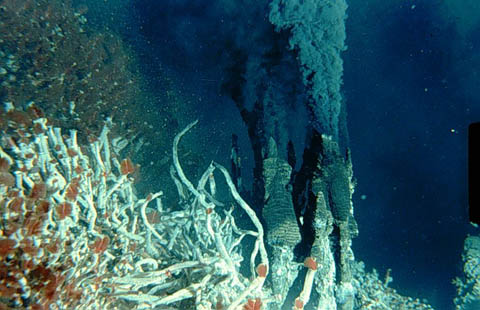
The main two reasons behind the sea being salty are Hypothermal vents and Rain.

For some unmentioned reasons, chemistry A level students are required to recite the following:
The model for earth is that plate tectonics “float” on liquid mantle, and that they move due to currents caused by the constant change of mantle density resultant of nuclear shizzle radiating in the core.


So right, at the bottom of the ocean, those “trenches” allow the water to seep in. As the water seeps in, it flows against the molten mineral rocks, becoming a solution of those minerals and the water.


When the solution rises back to the ocean water, they cool down from the lethal 400 C’ to become black smokers ejecting sulphur and other minerals into the ocean, making a brilliant environment for bacteria to feed, colonise and grow.


The reason bacteria feed on this crap is because there’s no light for plants to photosynthesise at the bottom of the ocean so they have very different respiratory systems which were passed onto other life forms via evolution et cetera et cetera.

Then, as things are in the sea, big stuff eat smaller stuff. So the crabs would eat the bacteria for example.

Tuesday, 23 November 2010

Entropy

Not to be confused with Enthalpy.


Entropy is the degree of disorder.
Systems will move to a state of maximum disorder unless forced otherwise. (E.g. Tidying a room: If a room is not tidied periodically, it will eventually reach a state of optimum chaos)


exampli gratia, 
Diamond has a very ordered structure, so it's least disordered, so it has a low Entropy.


Gases don't have ordered structures, so they're most disordered, so they have a great Entropy.

Solids have the lower entropy.

Liquids have a medium entropy.

Gases have the greatest entropy.

Wednesday, 17 November 2010

Epsom Salts

Salts used by Victorians as a medical remedy. They're Magnesium Sulphates, made by bonding Magnesium Carbonate and Dilute Sulphuric Acid.


MgCO3 (s) + H2SO4 (aq) --> MgSO4 (aq) + CO2 (g) + H2O (l)

Alternative Fuels

  • Ethanol and Bio Diesel
E.g. From Sugar Canes via fermentation.

Pro - Some CO2 is captured and 'reused'.
Pro - Reduces the demand for fossil fuel.
Con - More expensive than fossil fuels.
Con - Plants are fragile.
Con - Ridiculous land needed to provide the amount of fuel required.

  • LPG - Liquefied Petroleum Gas
60% Propane, 40% Butane

Pro - Less CO, NO, and unburnt fuels.
Pro - Cheaper as compared with common fossil fuels.
Con - Difficult to store.
Con - Greater evaporative emissions.

  • Hydrogen
Can be consumed in two ways:
1- Via burning: Like common fossil fuels, producing some NOx and water.
2- Via fuel cells: taking place in a cell rather than an engine, producing pure electricity.

Pro - Little or no pollution.
Pro - Semi infinite source of energy.
Con - Difficult to manufacture and store.

*Can be obtained from water via electrolysis.

  • Nuclear Energy
Produced via the breaking down of unstable nuclei.

Pro - Long life span.
Con - Expensive and difficult to build and manufacture.

Sunday, 14 November 2010

Mass Spectrometry

Used to measure the atomic or molecular mass of different particles in a sample.

This is like totally awesome because chemists can demonstrate how badass they are by doing CSI stuff with it.

Now there are many different mechanisms in which Mass Spectrometry can be done through, but because you’re just a dim-witted student, you only need to know one. Funnily enough referred to as “Mass Spectrometers”.

Those things sound like they come from Star Wars, but really if you break them down, they’re just as complex as a toaster. Not that you, as a dim-witted student would know how a toaster works. Did you know that the adjusters on toaster are actually timers in minutes, not power levels which is the common misconception.

Breaking a Mass spectrometer down, you’d find three main parts,
An Ioniser, or if you’re feeling Fat and Patriotic, you could call it an Ionizer. All the same: The ioniser is where the sample goes after being injected from a sample inlet for it to get turned into ions, clue is in the name. This is done by bombarding the little stream of sample with electrons. ELECTRONS EVERYWHERE. Btw, if you put the word “Sea of electrons” you deserve to die, because that’s not acceptable A level Chemistry terminology, but since you’re a dim-witted student, the examiner might let you off.

General formulae for what happens in the ioniser zone of a mass spectrometer:
X(g) + e- à X+(g)+ 2e-

The Analyser, or if you’re a fat patriot, you might know it as the analyzer, is the second component in a Mass Spectrometer.

The crap thing about the analyser for a student is that there are so many different types of it. The one you should bear in mine is the one that measures time of flight of the ions. Basically, ions are accelerated using whatever method, usually a magnetic pulse, so that they’re all strolling with the same level of energy, in the same direction, and the fatter ions take longer than the skinny ions to cross a certain distance. This is called measuring the “Time of flight”.

After the ions go through the analyser, and get all analysed and so forth, they go into the Detector chamber, where ions are deteced by an ion detector. The detector produces a varying electric current depending on the ion it got hit with, and the “computer” registers this as a piece of data which eventually gets compiled into an Abundance/Charge graph, aka Mass Spectra!

Monday, 8 November 2010

Molecular shape structures - As far as an A level student needs to know.

Tetrahedral
(E.g. Methane CH4)
109 degrees apart.

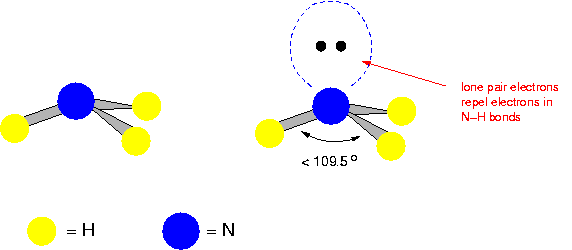
Pyramidal
(E.g. Ammonia)
109 degrees apart.


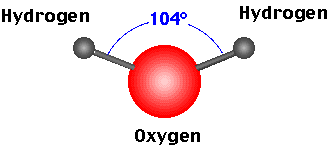
Bent
(E.g. Water)
104 degrees apart.

Linear
(e.g. BeCl2)
180 degrees apart

Planar Triangular 
(E.g. BF3)
120 degrees apart, and two dimensional

Trigonal bipyramidal
(E.g. Phosphorus Pentachloride)
120, or 90 degrees apart

Octahedral
(E.g. Sulfur hexafluoride)
90 degrees apart on all planes.