One of those things that you stumble upon on the internet, add to your favourites because you think it's interesting and never go back to.
Have a look.
http://en.wikipedia.org/wiki/Aqua_regia
Sunday, 27 February 2011

Monday, 7 February 2011
Electronic Structure. A bit further detail.
Basically, In GCSE, you were lied to because you were (And probably still are) too dumb to understand the concept that orbitals are fake. Kinda.
Electrons are actually held in Subshells within Shells.
So starting from basic to complex:


Electrons are actually held in Subshells within Shells.
Capacity Hierarchy:
Sub-shells > Shells > Orbitals
So starting from basic to complex:
- Shells are the big "Circle" or "Orbit" around the element.
- Sub-shells are smaller shells that form the big Shells.
- The number of Subshells in a Shell = The number of the shell.
Like this!

- For example, Shell 3 (n=3) has 3 sub orbitals.
- Subshells come in different capacities.
'S' can hold 2 electrons.
'P' can hold 6 electrons.
'D' can hold 10 electrons.
'F' can hold 14 electrons.
- Orbitals are the very small thing. A part of a subshell. There is a maximum of 2 electrons held in each orbital.
In summary, this is the hierarchy of electronic configuration of Sub-shells:
For example (Putting this into use)
The electronic sub-shell configuration of Gold:
1s2, 2s2, 2p6, 3s2, 3p6, 3d10, 4s2, 4p6, 4d10, 4f14, 5s2, 5p6, 5d10, 6s1
Where as the first number (Before the letter) is the Energy Level.
Where as the second number (After the letter) is the Number of Electrons held in the subshell.
Putting it into order to make it look tidy:
The things this can tell us:
Friday, 28 January 2011
Halogens
The Halogens are 5 non metallic group 7 elements in the periodic table. They have slightly different properties because of their electronic setting (having 7 electrons in their outermost shells).

In terms of patterns and trends, as you move further down the group, electronegativity and reactivity decreases, while boiling points increase. (Exception of Astatine, because that stuff's radioactive).
Halogens have a high electronegativity, and are particularly reactive to form stable ionic crystals (Salts) as the name suggests, halo meaning salt and gen meaning to form.
**Sodium Chloride is the most abundant Halogen-produced Salt**
 |
| Sodium Chloride Crystals |
The charge density of the nucleus of Halogens is important because it shows that they have a high proton charge, which grants them a good electronegativity making them ideal anions, for pairing with the 1st group cations such as Na+.
Halogens, as they have 7 electrons in their outer shells, have an oxidation number of -1, with a few exceptions, for example if it was binded with Oxygen or another Halogen that is more reactive, with Fluorine being the most reactive one.
The difference in reactivity between the group 7 elements is within the fact that they're in consecutive periods, meaning there's a hierarchy relating between the number of outermost shells and the reactivity of the element. This is relating to the idea that more rings around the nucleus make the outer-most shell further away from the centre point of electronegativity, so the pull is spread over a large area decreasing its concentration.
Halogens as oxidation agents follow this general form:

Sunday, 23 January 2011
Electrophilic Addition
Electrophilic addition is basically this:


As the chilling alkene gets shanked by the retarded bond, one of its bonds snaps off. The electron's left hanging there.


And then,
 So, we end up with this:


Like when you have a retarded bond that decides to jam itself into an unsaturated alkene. A bit like that relative you never liked.
This happens in some stupid stages you're meant to remember. As if it'll mean anything to you in life.
Stage number one. The retarded bond ATTACKS the chilling alkene.

As the bond's snapped off, the retarded bond makes advantage of this via exploiting the open port, as the following diagram illustrates.

And then we get this:


Friday, 10 December 2010
Ionic Substances
Formed due to the loss or gain of electrons.
To make ions, an ionisation energy is required.
Ionisation energy is the amount of energy sufficient to remove an electron from the outermost shell of an atom.

The general equation for this is:
X (g) à Na+ (g) + -1 e
When an outermost shell has been exhausted, and you start taken electrons off the next shell (Which would be full), the ionisation energy increases significantly.
I.e. All element is group one, have a large 2nd ionisation energy. (Trying to remove the second electron)
Ions in solids
Ionic solids are giant lattices formed from ions being arranged in a regular way, and are held together by electrostatic bonds between oppositely charged ions.

This type of ionic bond is relatively strong and needs a large energy to overcome. For this reason, they have high melting and boiling points, so they tend to be solid at STP.
Ionic substances cannot conduct electricity when solid, but they can when in an aqueous solution.
The two ways of integrating H2O into an ionic substance:
1- 1- Water of crystallisation: Water sits in between ions of solids.
Example is Hydrated Copper Sulphate.
We include the water in the formulae. E.g. CuSO4.5H2O
2- 2- Hydration: Aka good old Dissolving.
Wednesday, 1 December 2010
Concentration Calculation
There are two methods to do concentration calculations, but to my concern as an Alevel chemist, only the following one is “Useful” because it includes Moles which can tell you a lot more about the substance and what its properties are as opposed to the singular sample you have in the experiment.
Concentration = Amount in moles ÷ Volume in cubic decimetres
1 decimetre cubed is equal to 1000 centimetres cubed!
Solutions in Geographical context
The following is mostly Geology and Biology and is of little interest to a real chemist.
The main two reasons behind the sea being salty are Hypothermal vents and Rain.
For some unmentioned reasons, chemistry A level students are required to recite the following:
The model for earth is that plate tectonics “float” on liquid mantle, and that they move due to currents caused by the constant change of mantle density resultant of nuclear shizzle radiating in the core.

So right, at the bottom of the ocean, those “trenches” allow the water to seep in. As the water seeps in, it flows against the molten mineral rocks, becoming a solution of those minerals and the water.

When the solution rises back to the ocean water, they cool down from the lethal 400 C’ to become black smokers ejecting sulphur and other minerals into the ocean, making a brilliant environment for bacteria to feed, colonise and grow.
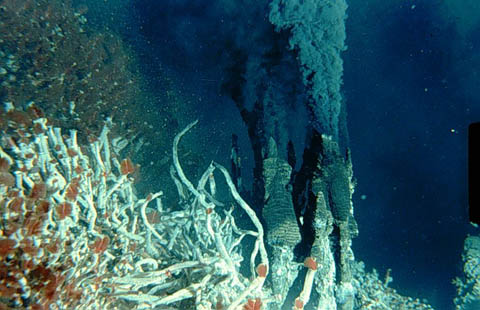
The reason bacteria feed on this crap is because there’s no light for plants to photosynthesise at the bottom of the ocean so they have very different respiratory systems which were passed onto other life forms via evolution et cetera et cetera.
Subscribe to:
Posts (Atom)